- English version below -
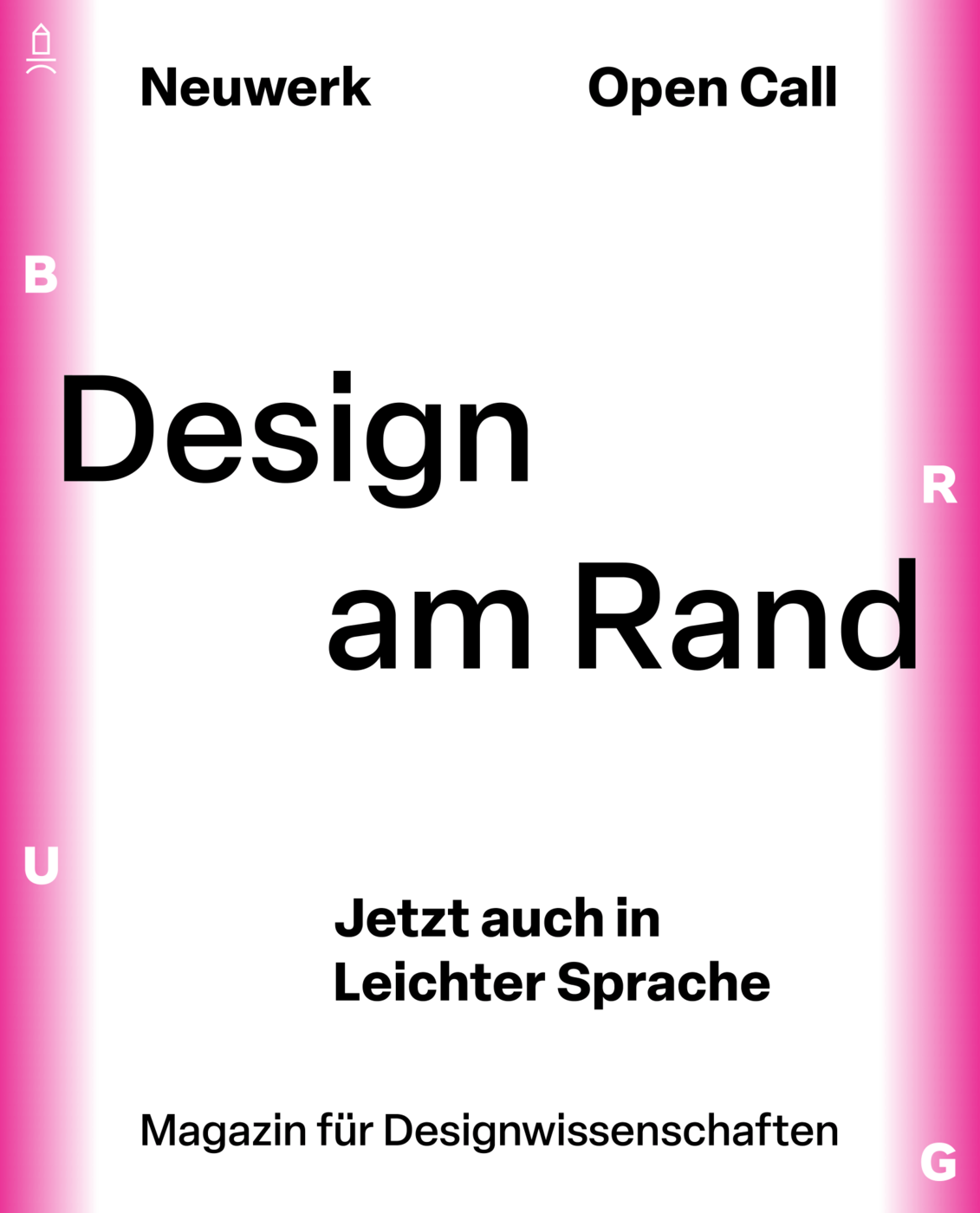
Am Rand zu sein ist sowohl ein Standort, eine Beziehung, als auch ein Zustand. Es ruft Bilder von Inklusion und Exklusion hervor, Orte der Nonkonformität, menschlicher Entfaltung, Prekarität und Zuflucht – ein Zustand, der aktiv angestrebt und gefeiert, aber auch als verletzend und unterdrückend erlebt werden kann. Genau diese ambivalente und schöpferische Natur des Randständigen möchten wir in der nächsten Ausgabe des Neuwerk-Magazins einfangen.
Betrachten wir aus designwissenschaftlicher Sicht einen Rand, so müssen wir auch auf den soziologischen Begriff der Devianz zurückgreifen. Deviant ist, was nicht mit den vorherrschenden gesellschaftlichen Normen und Werten übereinstimmt. Das stetige Aushandeln des Wertesystems sorgt für dessen Weiterentwicklung und letztendlich für eine Bestätigung des Systems.
Ähnliche Dynamiken lassen sich auch bei Ästhetiken beobachten, die aus dem Mainstream ausbrechen. Oftmals stammen diese aus Subkulturen, werden aus ihrem ursprünglichen Kontext gerissen und somit ästhetisiert. Auch Ästhetiken, die losgelöst von sozialer Marginalisierung entstehen, können deviante Dynamiken annehmen und sich vom Rand in den Mainstream der Designindustrie bewegen.
Exemplarisch spielt der von Susan Sontag beschriebene Begriff Camp als bewusst subversive und alternative Sichtweise mit dem Übertriebenen und dem Künstlichen. Dabei geht es um eine gruppeninterne Sprache und Ästhetik, die sich innerhalb marginalisierter Gruppen, insbesondere im queeren Kontext, bildete. Versuche, Camp mehr in den Mainstream zu verlagern, sind mit einem destruktiven Effekt auf dessen Integrität verbunden.
“To talk about Camp is therefore to betray it.”
(Susan Sontag in Notes on Camp, 1964)
Im Verhältnis zum Mainstream bräuchte es also eine Dynamik, die Andersartigkeit respektiert, ohne sie verstehen oder restlos entschlüsseln zu müssen. Für Menschen mit Migrationsgeschichte kann dieses Konzept besonders wichtig sein. Édouard Glissant beschreibt im Kontext kolonialer Gewalt ein Right to Opacity, das sich insbesondere von der Forderung nach Transparenz abgrenzt.
Der Rand kann ein Safe Space sein, aber auch Ausgrenzung und Diskriminierung bedeuten. Das Verhältnis zwischen Mensch, Gesellschaft und Umwelt lässt sich dabei nicht als starre Zuschreibung von Eigenschaften an Personen erfassen. Das relationale Modell von Behinderung schärft die Grenzen des sozialen Modells dort, wo es die Materialität des Körpers kaum erfasst und intersektionale Perspektiven vernachlässigt. Behinderte Menschen erfahren Ausschlüsse in der Gestaltung der (gebauten, sozialen, …) Welt: Stufen, Schwellen, schwere Texte, fehlende Rücksicht materialisieren systemische Ungerechtigkeiten.
Institutionen setzen oft auf kodifizierte Normen und gesetzliche Mindeststandards, ohne behinderte Menschen in Designentscheidungen einzubinden. Ausschluss ist kein Planungsfehler, sondern Strukturprinzip. Antiableismus erfordert ein Verständnis von Zugang, das Würde nicht bloß als das Einhalten von Standards begreift, sondern als Haltung hin zu Disability Justice.
Einreichungsmodalitäten:
Zu diesen und weiteren Aspekten, Themen, Perspektiven und Fragen sucht die 13. Ausgabe des Neuwerk Magazins designbezogene Beiträge aller Art: Einreichungen, die aus einer gelebten, intersektionalen oder marginalisierten Position heraus entstehen. Mit dem Magazin soll es einen Raum für das Aufeinandertreffen verschiedener Wissenspraktiken geben.
Begrüßt werden wissenschaftliche wie nichtwissenschaftliche Texte (bis 12000 Zeichen inkl. Leerzeichen), Fotostrecken, Filme, Sound Art, Field Recordings, Gedichte, Skizzen, Objektdokumentationen, etc. Texte in Leichter oder Einfacher Sprache sind explizit erwünscht. Disability Expertise, vernakuläres Wissen und erfahrungsbasierte Praxis als Erkenntnisquellen sind insbesondere willkommen. Das geplante hybride Publizieren auf unserer Webplattform ermöglicht multimodale Erfahrbarkeiten verschiedener Inhalte.
Diese und weitere Themen und Aspekte eröffnen eine Reihe von Fragen, die als Ausgangspunkt für Einreichungen dienen können: Ästhetiken entstehen in Kontexten und verlassen sie. Form und Inhalt müssen nicht miteinander verknüpft sein.
- Wann wird Design zum Instrument der Kulturindustrie und wann entzieht es sich ihr?
- Inwiefern ist die Designwissenschaft selbst Teil jener Industrie, die sie zu analysieren versucht?
- Welche Gegenkultur ist heute noch möglich, wenn Subkultur zur Marke wird?
- Muss sich bei der Verwendung von Ästhetiken ihrer Wurzeln bewusst gemacht werden?
Widerstand hat eine Geschichte der Bilder, der Parolen, der Gesten. Viele sensorische Dimensionen des Protests bleiben dabei unsichtbar.
- Wie riecht Widerstand?
- Wann ist strategischer Essentialismus die Antwort?
Gruppeninterne Sprachen und Ästhetiken helfen marginalisierten Personen dabei, ein Gefühl von Handlungsfähigkeit und Zugehörigkeit zu erlangen. Opazität kann einen Schutzraum ermöglichen.
- Welche Rolle spielen Transparenz und Opazität im Kontext kolonialer und patriarchaler Gewalt?
- Wie kann für opake Gruppen gestaltet werden oder ist das die falsche Frage?
- Wie manifestieren sich Sub- und Gegenkultur sowie Anti-Design im Kontext zum Mainstream?
- Is Camp dead? Did we betray it?
Gesellschaftliche Normen entscheiden darüber, welche Menschen als behindert gelesen werden, wer Unterstützung erhält und wer sich erklären muss. Zwischen dem Anspruch universeller Gestaltung und erfahrener Marginalisierung besteht eine Schieflage.
- Wie gestalten behinderte Menschen ihre Umwelt?
- Welche widerständigen Ästhetiken erfinden behinderte Designer:innen (Access Aesthetics, Crip Curating etc)?
- Welche Gestaltungspraktiken entstehen zwischen Normierung und gelebter, vernakulärer Disability Expertise?
- Wo stehen Universal und Accessible Design heute?
- Warum gilt Barrierereduktion oft als schwierig umsetzbar? Welche konkreten positiven Beispiele gibt es für anti-ableistische Transformationsprozesse?
Literaturhinweise:
Adorno, Theodor W.: Résumé über Kulturindustrie. In: Theodor W. Adorno: Ohne Leitbild. Parva Aesthetika. Suhrkamp 1979.
Glissant, Édouard: Poetics of Relation. penguin classics 2025.
Hartblay, Cassandra: Disability and Accessible Design in Contemporary Russia. cornell university press 2025.
Kafer, Alison: Feminist, Queer, Crip. Indiana University Press 2013.
Malczok, Melanie: Strategische Devianz: Potentiale und Risiken ungehorsamer Ästhetik in der Kommunikation sozialer Bewegungen. In: Nils S. Borchers, Selma Güney, Uwe Krüger und Kerem Schamberger (Hrsg): Transformation der Medien – Medien der Transformation, Verhandlungen des Netzwerks Kritische Kommunikationswissenschaft. Westend 2021.
Sontag, Susan: Notes on Camp. penguin modern 2018.
T. Anna: Opacity – Minority – Improvisation. An Exploration of the Closet Through Queer Slangs and Postcolonial Theory. transcript 2025.
on the margin(s)
Margins are simultaneously a location, a relationship, and a state of being. Being on the margins evokes images of inclusion and exclusion, sites of nonconformity, human flourishing, precarity, and refuge — a state that can be actively sought and celebrated, but also experienced as harmful and oppressive. It is precisely this ambivalent and creative nature of marginality that we aim to explore in the next issue of Neuwerk Magazine.
When we examine the margin from the perspective of design studies, one pathway leads to the sociological concept of deviance, or that which does not conform to prevailing social norms and values. To name or claim something as deviant relies for its meaning and force on the normative value system from which that something diverges, which can inadvertently confirm the centrality and dominance of that system.
Similar dynamics can also be observed in aesthetics that exist outside of the mainstream. These often originate in marginal subcultures, are just as often torn from their original context, and made available for mainstream incorporation, appropriation, and exploitation. Even aesthetics that emerge independently of social marginalization can find themselves pulled from the margins into the mainstream of the design industry.
A prime example is the concept of camp described by Susan Sontag as a deliberately subversive and alternative perspective that plays with the exaggerated and the artificial. It refers to an internal language and aesthetic that developed on the margins of mainstream society, particularly in queer spaces. Attempts to shift camp further into the mainstream have had a destructive effect on its affective power as well as the integrity of queer social formations. This poses particular challenges for those who would attempt to document or theorize aesthetics on the margins.
“To talk about Camp is therefore to betray it.”
(Susan Sontag in *Notes on Camp*, 1964)
One response is to develop ways to respect otherness without having to fully translate it into normative terms and frameworks. For people with a history of migration, this approach can be particularly important. In the context of colonizing forms of violence and their demand for transparency, Édouard Glissant describes a right to opacity. How might design studies develop methods of documentation and analysis that take this right into account?
And while being on the margins can provide refuge and experiences of relative empowerment, it can also be the effect of exclusion and discrimination. Nowhere is this clearer than the marginalization of people marked as disabled. The relational model of disability makes clear that disability is not a medical condition but the combined effect of bodily attributes, social attitudes, and the built environment. In other words, the experience of disability is produced through the designs of the physical and social world; from steps and thresholds to difficult-to-understand texts, technological exclusion and the willful ignorance of others, systemic marginalization is materialized in ways both large and small.
Moreover, institutions often generate or rely on codified norms and legal minimum standards without involving people with disabilities in design decisions. Such ableist exclusions are thus not a planning error, but a structural principle. To fight such exclusions, might we need an approach to access that combines questions of design with concepts of in/justice?
Submission Guidelines:
The 13th issue of Neuwerk Magazine is seeking design-related contributions of all kinds on these and related topics, including those that emerge from lived, intersectional, or marginalized positions. The magazine aims to provide a space for the convergence of diverse knowledge practices.
We welcome both academic and non-academic texts (up to 12,000 characters, including spaces), photo series, films, sound art, field recordings, poems, sketches, object documentation, etc. Texts in plain or simple language are explicitly encouraged. Disability expertise, vernacular knowledge, and experience-based practice as sources of insight are particularly welcome. The planned hybrid publishing on our web platform will enable multimodal experiences of various content.
These and other themes raise a series of questions that can serve as a starting point for submissions:
- Aesthetics emerge from contexts and transcend them. Form and content need not be linked. Must we be mindful of the origins of aesthetics when using them in new context and for new purposes?
- What kind of counterculture is still possible today given the diverse incentives to turn subcultures into marketable brands?
- To what extent is design studies itself part of the very industry it seeks to analyze and critique?
Resistance to mainstream politics and dominant norms has long been understood through visual aesthetics of images, slogans, and gestures. Many sensory dimensions of resistance and protest remain imperceptible in such an understanding.
- What does resistance smell or taste or otherwise feel like?
Internal group languages and aesthetics help marginalized people gain a sense of agency and belonging. Opacity can create a safe space.
- What role do transparency and opacity play in the context of colonial and patriarchal violence?
- How can we design for opaque groups — or is that the wrong question?
- How do subcultures, countercultures, and anti-design manifest themselves in relation to the mainstream?
- Is Camp dead? Did we betray it?
Social norms and the built environment of designed things determine which people are perceived as disabled, who receives support, and who is required to explain themselves. There is a disconnect between the ideal of universal design and the reality of experienced marginalization.
- How do people with disabilities design their environment? What forms of resistant aesthetics are disabled designers inventing (Access Aesthetics, Crip Curating, etc.)?
- What design practices emerge between standardization and lived, vernacular disability expertise?
- Where do universal and accessible design stand today?
- Why is barrier reduction often considered difficult to implement? What concrete positive examples exist of anti-ableist transformation processes?
References:
Adorno, Theodor W.: Résumé über Kulturindustrie. In: Theodor W. Adorno: Ohne Leitbild. Parva Aesthetika. Suhrkamp 1979.
Glissant, Édouard: Poetics of Relation. penguin classics 2025.
Hartblay, Cassandra: Disability and Accessible Design in Contemporary Russia. cornell university press 2025.
Kafer, Alison: Feminist, Queer, Crip. Indiana University Press 2013.
Malczok, Melanie: Strategische Devianz: Potentiale und Risiken ungehorsamer Ästhetik in der Kommunikation sozialer Bewegungen. In: Nils S. Borchers, Selma Güney, Uwe Krüger und Kerem Schamberger (Hrsg): Transformation der Medien – Medien der Transformation, Verhandlungen des Netzwerks Kritische Kommunikationswissenschaft. Westend 2021.
Sontag, Susan: Notes on Camp. penguin modern 2018.
T. Anna: Opacity – Minority – Improvisation. An Exploration of the Closet Through Queer Slangs and Postcolonial Theory. transcript 2025.