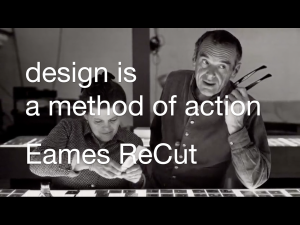
Charles & Ray Eames used film as a “tool,” and asserted that their films were vessels for an idea. For them, the idea was more important than the medium. When one interviewer proposed that their films might be interpreted as experimental, Charles replied, “They’re not experimental films, they’re not really films. They’re just attempts to get across an idea.” Paul Schrader, in the lone academic article about their films, “Poetry of Ideas,” published in Film Quarterly in 1970, said, “The classic movie staple is the chase, and Eames’ films present a new kind of chase, a chase through a set of information in search of an Idea.”
Der vollständige Artikel unter:
snoreandguzzle.com/?p=149
Introduction Films of Charles and Ray Eames (7:11)
The Films of Charles & Ray Eames
Charles & Ray Eames were artists adept at an astonishing number of disciplines. They produced museum exhibitions, architecture, logotypes, toys, slide-shows, furniture, books, photography, paintings and over 100 films. However, their films are the least discussed of their output. One of the main reasons is the sheer difficulty in acquiring access to them. Only about a quarter of their films have been released on home video. They are one of the few American artists with an entire era named after them, but their films are rarely placed on a level with their furniture or architecture. And yet their films contain some of the most generous, sincere and original ideas of the century.
Der vollständige Artikel unter:
snoreandguzzle.com/?p=149
Design Questions+Answers (1972) 5:28
A communications primer (1953)
Anna Daly at Senses of Cinema describes it as follows: “Schematic diagrams and simple associations serve to highlight the message: clear communication betters humanity. The film is thus an accomplished work of design as well as being a beautifully composed documentary that brings an artist’s feel for colour and composition to the moving image, ensuring visual delight despite theoretical archaism.”
Rezension in sensesofcinema.com/charles and ray eames
A communications primer Transcript als pdf-Datei
Tops (1969) 7:37
Toys occupy several of the Eames films, including Tops (1969), a purely visual film that documents the short life span of a spinning top. It’s essentially a silent anthropological film and captures tops from different cultures and eras. The Eames Office contained a menagerie of toys, and it was Charles who once asked rhetorically, “Who would say that pleasure is not useful?” Both Toccata for Toy Trains and Tops are shot from the extreme perspectives of close-ups – an expressionistic technique that lets the audience experience toys as if from the eyes of a child.
Solar Do-Nothing Machine (1957) 2:16
Powers of Ten (1977) 9:02
Powers of Ten (1977) is the Eames’ best known work and a culmination of many ideas and themes. It is also something of a skeleton key for understanding the rest of their work. It presents the profound idea of orders of magnitude, with the subtitle of the film being: A Film Dealing With the Relative Size of Things in the Universe and the Effect of Adding Another Zero. The film was originally developed in 1968 and was entitled, A Rough Sketch for a Proposed Film Dealing with the Powers of Ten and the Relative Size of Things in the Universe. The “rough sketch” in the title is testament to the Eames’ penchant for perpetually iterative design. This is the case for many of their projects — Tops was initially made in black and white in 1957, and perfected 12 years later in color; the Eames Lounger was an idea 30 years in the making; Powers of Ten took so long to evolve that in the time it took to produce, science had broken through yet another power in the understanding of quantum physics.
Der vollständige Artikel unter:
snoreandguzzle.com/?p=149
Kepplers Law (1974) 2:53
The Expanding Airport (1958) 9:26
Fiberglass Chairs (1970) 8:45
Eames Lounge Chair (1956) 2:08
SX 70 Polaroid (1972) 10:51
IBM Fair (1964) 7:33
//////////////////////////////////////////////////////////////////////////////////////////////////////////////////
Eames: The Architect & The Painter (2011)
von Jason Cohn, Bill Jersey
ist der erste Film über Charles & Ray Eames seit ihrem Tod im Jahr 1978 bzw. 1988. Er beschäftigt sich sowohl mit der privaten als auch mit der beruflichen Beziehung der beiden Designer, die gemeinsam zahllose Design-Klassiker entworfen haben.
Selbst diejenigen, die in den letzten Jahren keine der so zahlreich zu den Eames erschienenen Neuerscheinungen verpasst haben, erfahren bei Cohn und Jersey noch Neues, vor allem aus den Interviews mit Lucia Eames, Charles Tochter aus erster Ehe, dem Enkel Eames Demetrios, dem Filmemacher Paul Schrader, dem Ted-Mitbegründer Richard Saul Wurman und ehemaligen Mitarbeitern des legendären Eames Studios am 901 Washington Boulevard in Venice, Kalifornien. Mit fabelhaften Aufnahmen wird hinter die Kulissen der wie eine Wunderkammer bis zur letzten Ecke gefüllten Werkstatt geschaut, in der Charles und Ray insgesamt 45 Jahre ihren erfrischend heiteren Zirkus des Alltäglichen betrieben. Hier entstnad ganze Bogen: von den ersten Billigmöbeln im Ikea-Stil für Herman Miller bis hin zum Designer als visuellen Kommunikator des Informationszeitalters.
weiterlesen:
artnet.de/dokumentarfilm-eames-the-architect-and-the-painter