Standing and walking upright are probably the most distinctive physical characteristics that distinguish humans from animals. Over the course of evolution, many anatomical adaptations in humans have made this ability possible. Standing is not a state, but an activity. Standing is a struggle against gravity. Walking upright also occurs in opposition to the Earth's surface on which we move and, due to the distribution of mass in humans, is more like falling.
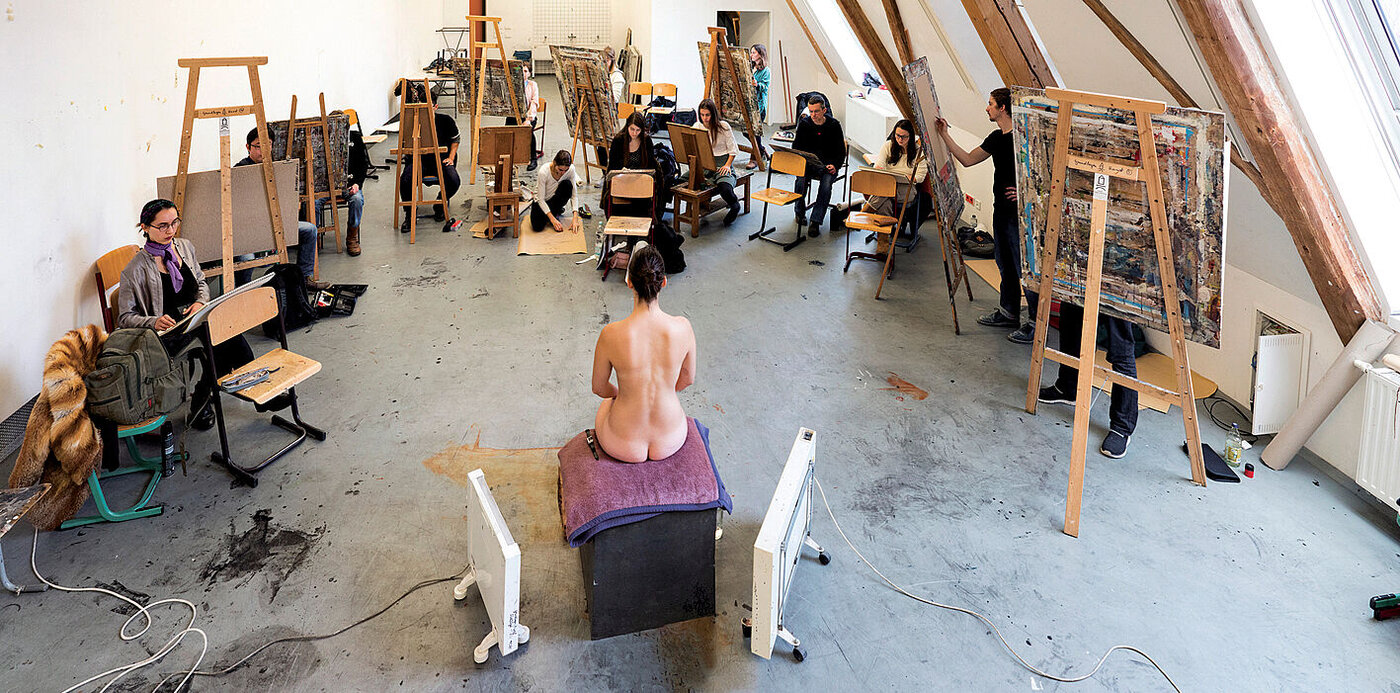
Anatomical form and function relationships and the possibilities of their reflection, morphology, anthropology and evolutionary history of humans are taught. Drawing in the anatomical collection of the Academy of Visual Arts Leipzig, in the zoological collection of Martin Luther University Halle, drawing from a model in the south wing of the castle
- Basic orientation of the human form ‘Symmetry and polarity, metamerism as basic formative patterns of the morphology of multicellular organisms’
- Standing upright, walking as if falling, movement becomes
- The spine ‘Layering and the S-shape as stabilisation of our posture’
- The rib cage ‘A basket, the basis for our breathing’
- The pelvis ‘Elvis was also called Pelvis - the centre of movement of our body’
- The thigh ‘How stretching a bone led to upright walking’
- The knee ‘when we still climbed trees’
- Tibia of the lower leg
- The foot via the ‘gripping foot’
- Final discussion
Steffen Bachmann