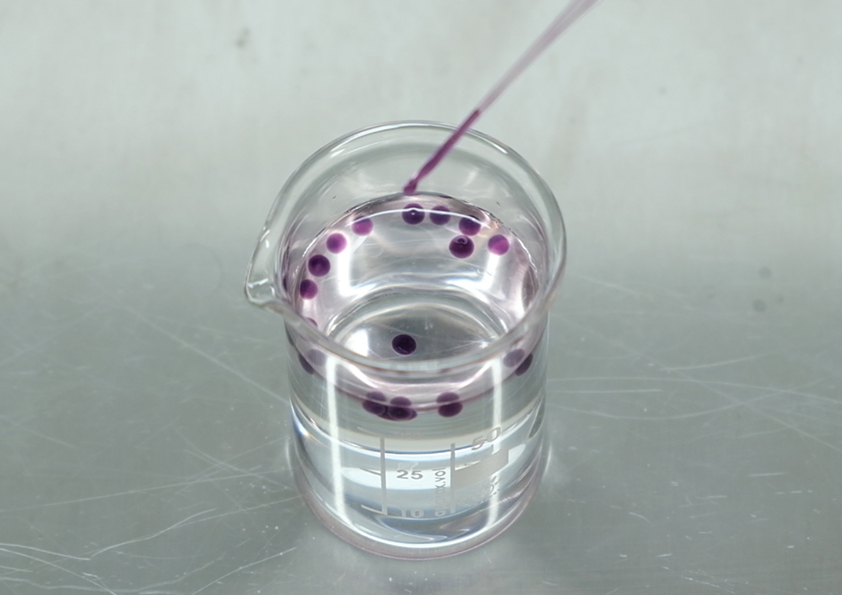
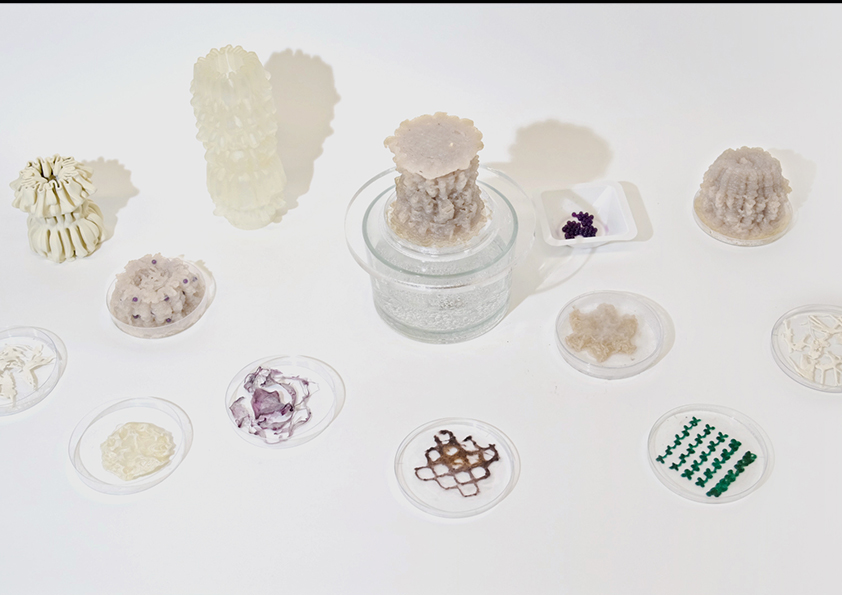
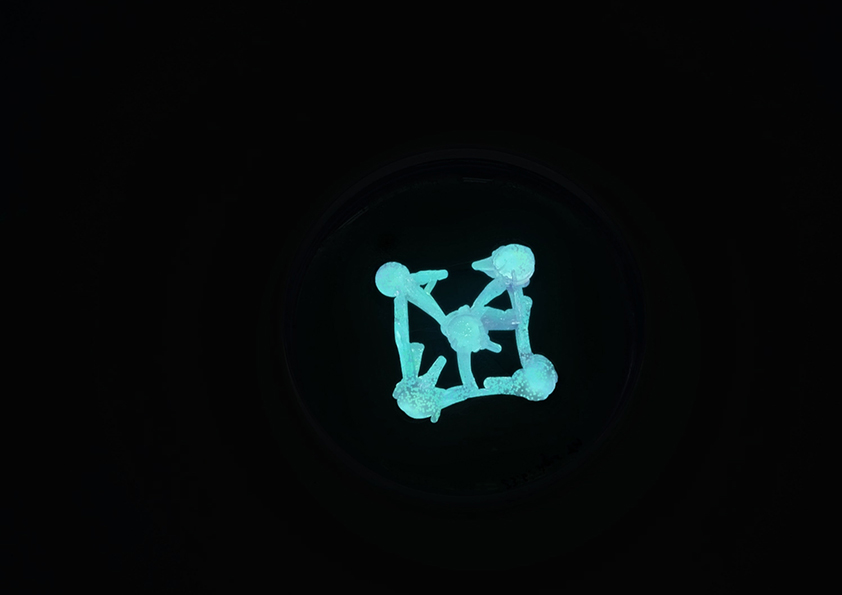
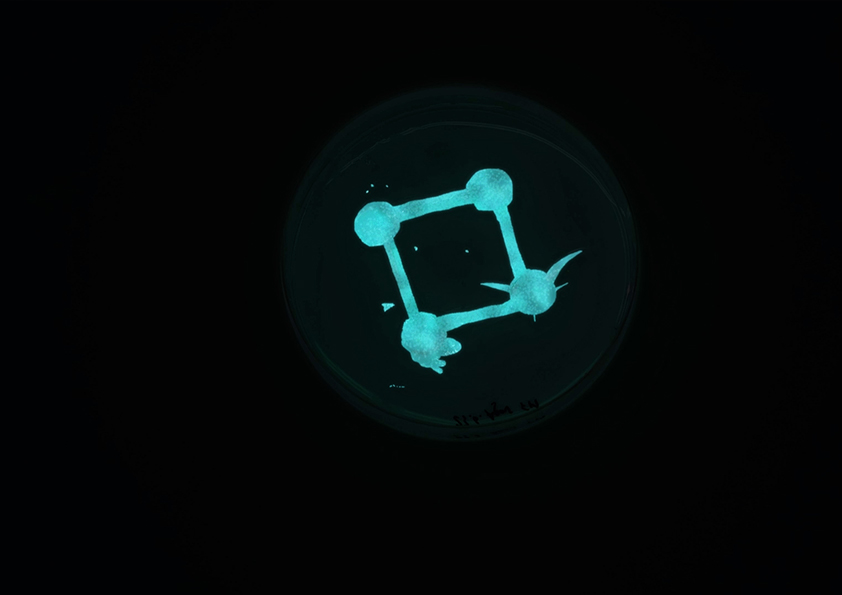
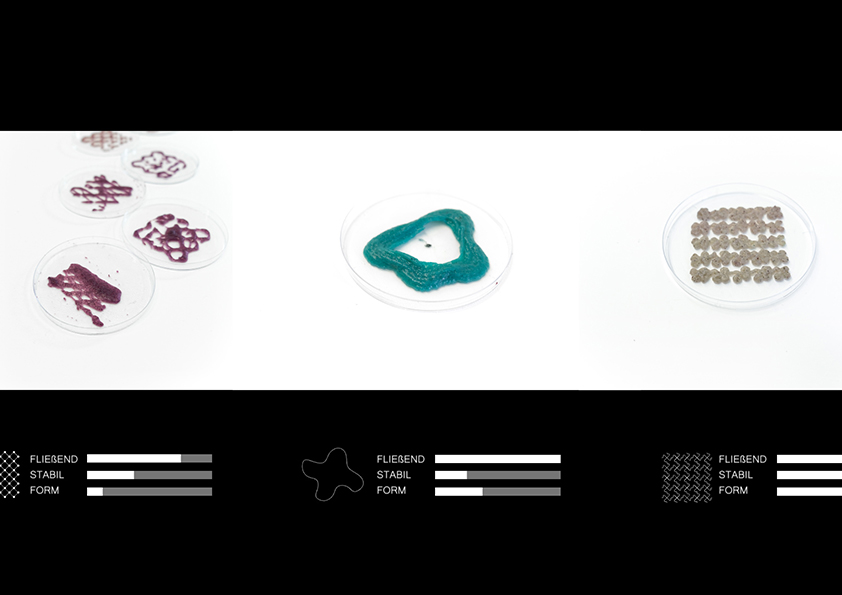
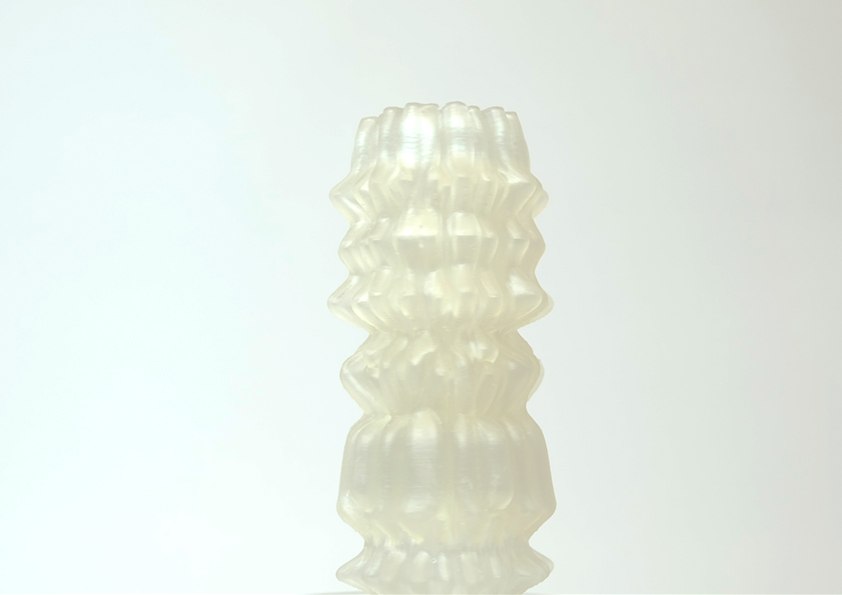
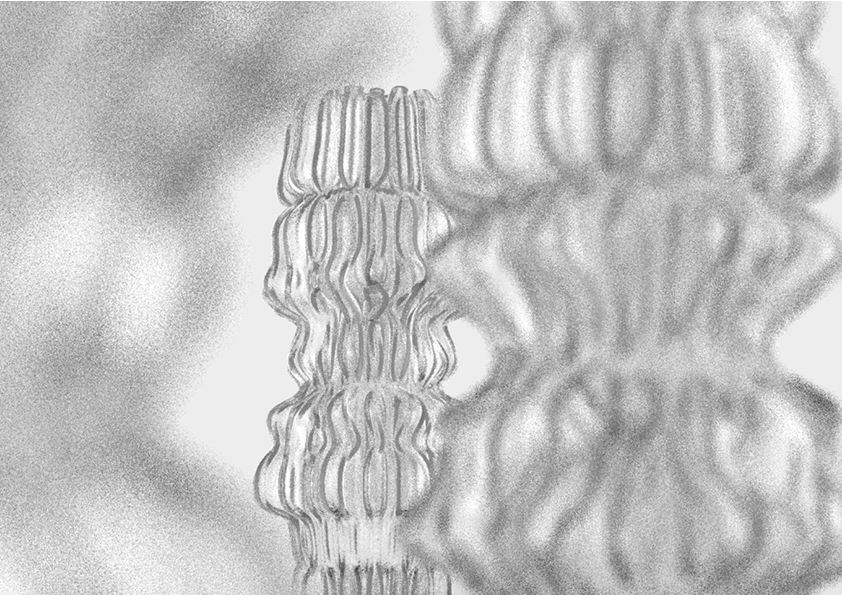
What if bacteria could be observed in a completely different way - up close and accessible? Could a three-dimensionally printed structure serve as a window for watching bacteria? Like ants behind glass, we could see how bacteria continue to live and grow in their optimal habitat. Would they give us signals about their environment? Could we learn from their behaviour? In this semester project, we set out on a journey to examine materials in a wide variety of compositions, test their printability, and ultimately offer a home to certain microorganisms. In perticular Alivibrio fisheri. A. fischeri is found in all the world‘s oceans, but is particularly prevalent in symbiosis with other marine life. Only when there are enough bacteria in the immediate vicinity do they begin to glow together. The ability to glow depends on the presence of oxygen. Only then does an enzyme called luciferase convert the oxygen into water and light. We want to fulfil these requirements in our structure and in our material. 3D printing gives us the creative freedom to build structures that allow us to observe the bacteria. We can also embed the bacteria selectively and maximize growth at specific locations. To do this, we mix our printing compound of solid and liquid material to generate an ideal consistency that extrudes evenly without losing its shape. Our series of experiments is designed to find a material that meets the requirements of bacteria while being printable. That is, moist, transparent and moldable. A gel-like consistency was created from psyllium husks, alginate and agar.
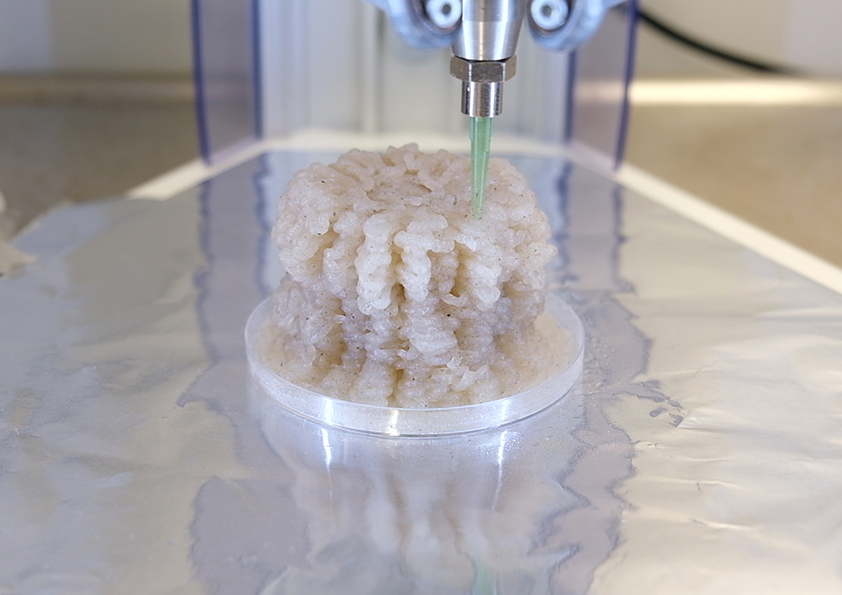
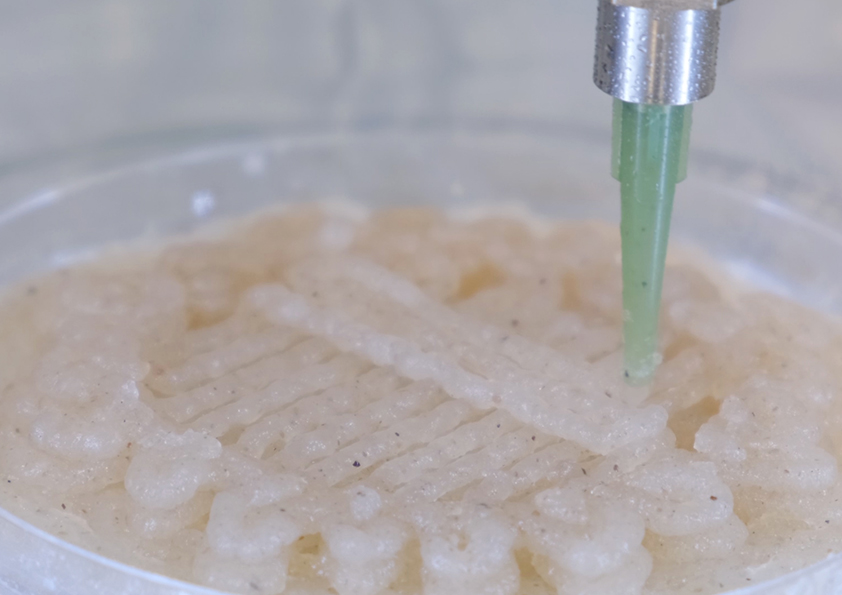
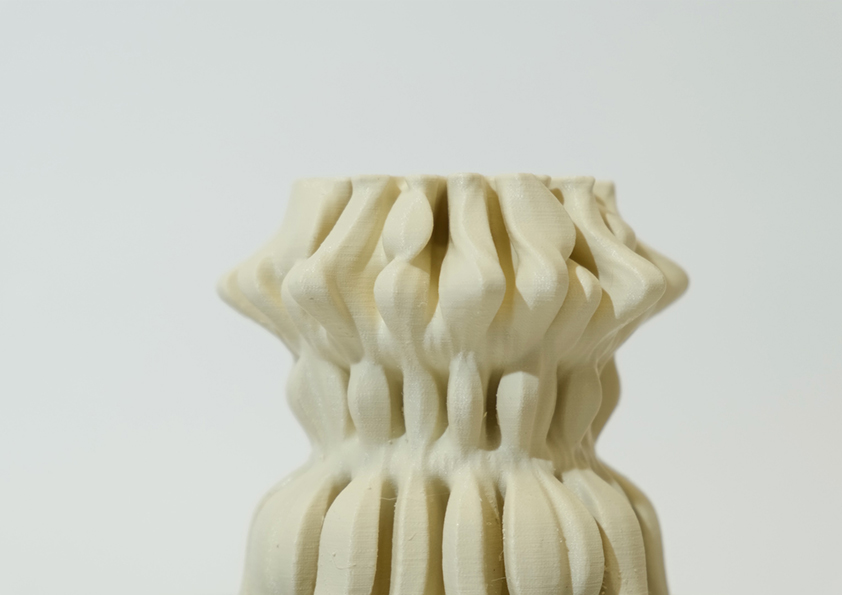
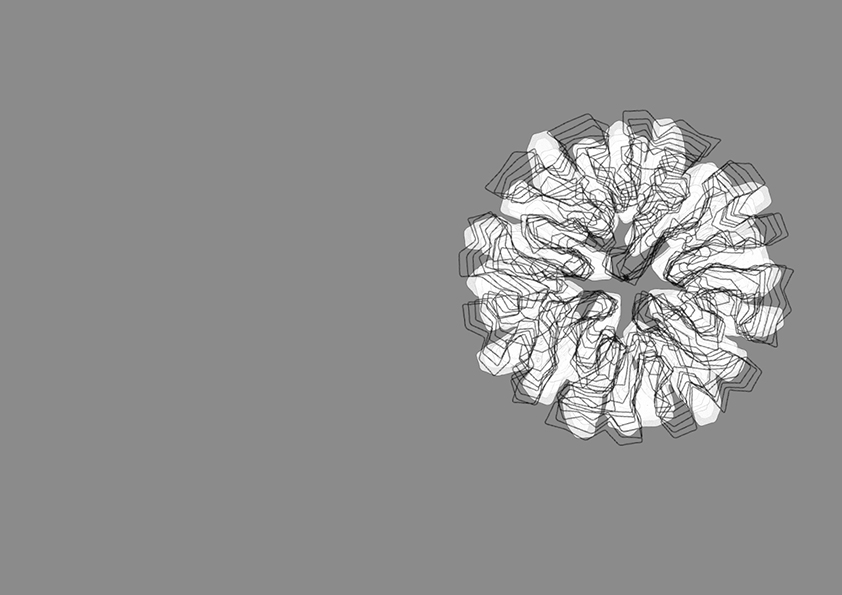
The printing tests showed that the higher the mass is printed, the faster it collapses. To get around these flaws, we found that smaller radii of curvature within the structure creates a mass that can support itself. Irregularities are also more likely to be forgiven with a curvilinear printed and soft biomass. We used an algorithm to form such curves that run just past each other within the structure. Thus, on the one hand, you create a stable shape that doesn‘t collapse in on itself and, at the same time, provides more surface area for the microorganisms.
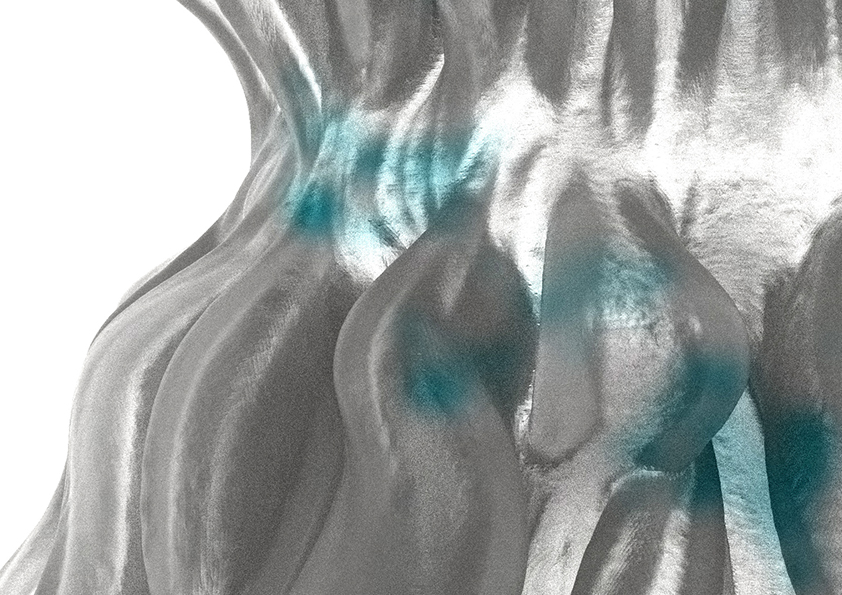
In the laboratory, bacteria are often cultivated on agar plates. In an experiment, we replaced the punched-out parts of the agar plate with LBS nutrient medium and spread the bacteria on it to check where the bacteria were most likely to grow. We applied this method to our 3D mass and it should show us that we can accelerate the growth of the bacteria in certain places in our structure and increase the concentration of it in a particular area. Before embedding the bacteria, it is mostly propagated, then pelleted. Its concentrated form, so to speak, is then taken and mixed into the mass. To have it survive and grow steadily, not only the material is important, but also the environment. As we already know, it is important to keep the bacteria in an oxygen-rich and humid habitat. Hydrogen peroxide could serve as a so-called oxidizer from below, supplying the air with oxygen and vaporized water. Just like it is used as an oxidizer in an aquarium. On top of the dish we placed a perforated glass plate on which the biomass stands and allows the vaporized water to pass through. The whole thing is kept sterile and protected by a glass bell. 3D printing gives us the freedom to design structures to observe the bacteria as they normally would behave only in the deepest ocean. Our fascination with these luminescent creatures is enlightened and we can now see them up close and glass clear.