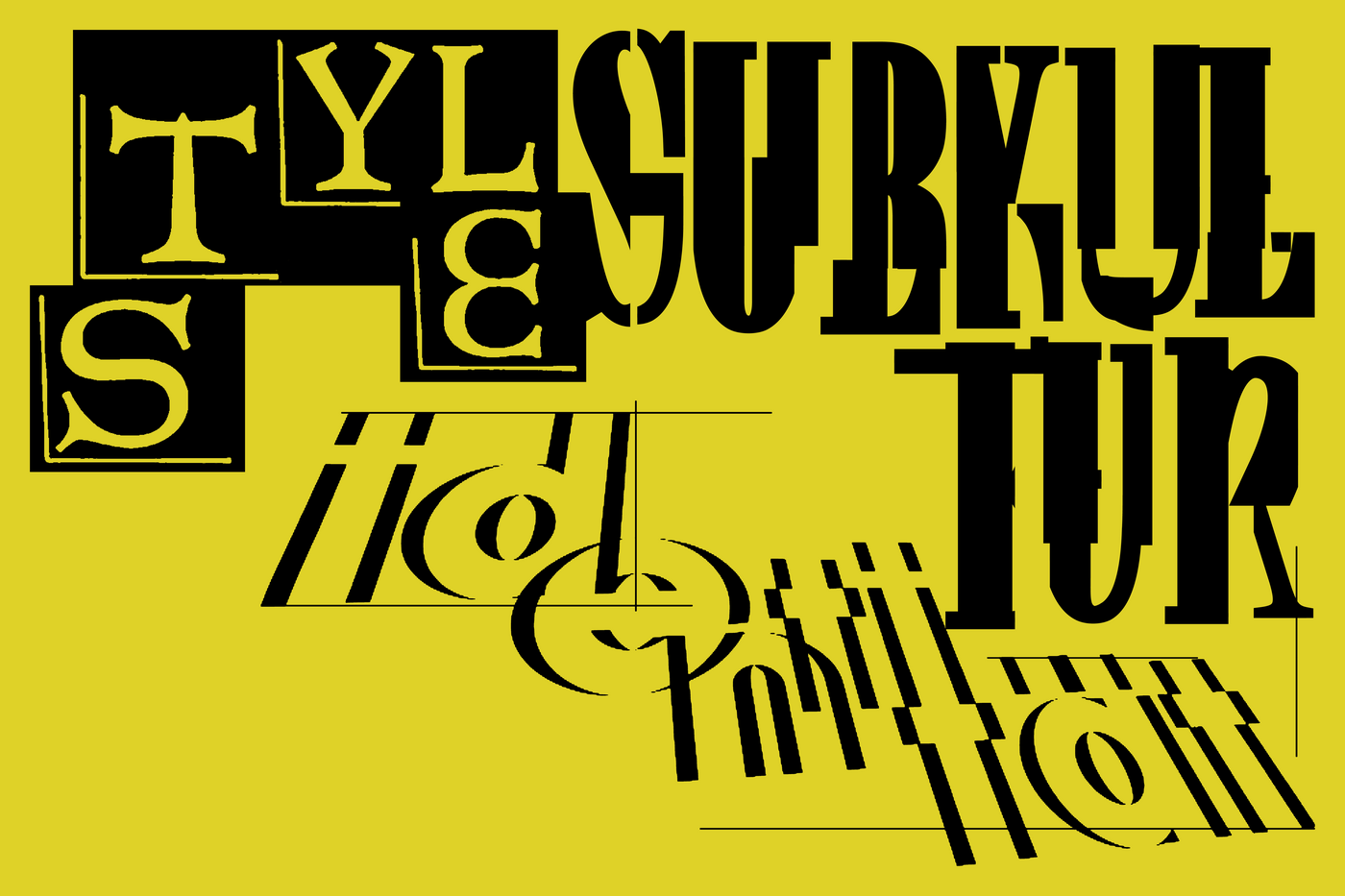
Style, Subculture, and Identity
In the upcoming winter semester, we will celebrate the unorthodox, the unconventional, and the idiosyncratic through the thematic framework of “Style, Subculture, and Identity”.
Together, we will investigate how visual codes emerge and how they circulate between niche, elite, popular, and subcultural contexts—being recombined, appropriated, and reinterpreted along the way. We will ask what defines subcultures, how individuals and communities express themselves through style, and how identities and spaces can be shaped through processes of appropriation and reinterpretation.
Throughout the semester, we will deliberately work across the fields of typography and type design.
We will approach these questions through a series of methods that combine research, collecting, and making:
- Discovering and Collecting
Searching for visual artifacts, objects, signs, language, codes, clothing, gestures, music, stories, and everyday cultural materials. - Observing and Interviewing
Conducting field trips, interviews, and research in everyday and subcultural contexts through conversations with witnesses, experts, and archival sources. - Organizing and Categorizing
Building archives, developing systems of classification, and revealing relationships and connections. - Selecting and Narrating
Curating, editing, and translating collected materials into new contexts and narratives. - Bootlegging, Remixing, and Appropriation
Copying, quoting, dismantling, combining, appropriating, reinterpreting, and remixing existing materials to create new meanings. - Making and Designing
Designing, experimenting, and improvising in order to discover new visual languages and design approaches through the act of making itself. Along the way, each participant will develop their own design libraries. - Translating and Producing
Realizing projects through a variety of printing techniques—from offset printing, risography, and screen printing to other experimental production methods. - Type Design Working Group
For everyone interested in type design, we will establish a Type Design Working Group (AG Type Design) dedicated to exploring all kinds of questions related to lettering and type design.
Structure
- Intro Week + Excursion: October 5–9 (Orientation Week)
- Every Monday, 2:30–6/7 pm: Master's Colloquium
- Every Tuesday, 9:30 am–6 pm and Wednesday, 10:30 am–4 pm:
Main studio program, consultations, and additional program activities (to be announced) - Wednesdays: Focus on Bachelor's and Master's thesis supervision
- Thursdays: Independent project work
- Intensive Project Weeks: October 26–30 (Week 3), January 11–15 (Week 12
These weeks are reserved entirely for the studio focus and project development. - Additional activities throughout the semester include: Excursions. Guest lectures and Workshops
Readings
The subcultural, as a code, becomes incorporated or assimilated into mainstream culture through commodities where any subversive power is lost.
[...] Any attempt to understand design as somehow fixed in a hierarchy of cultural spaces (high or good design versus low or kitsch design) or in a historical linearity of precedent and influence (originators and impostors) seems futile. Design should know that its place is not fixed, that design resides in all spaces. The traffic in signs that design produces circulates among these spaces, negotiating the differences of multiple positions of social and cultural identities.
Andrew Blauvelt, In and Around: Cultures of Design and the Design of Cultures
In the complexity of this social code, hair functions as a key "ethnic signifier" because, compared with bodily shape or facial features, it can be changed more easily by cultural practices such as straightening. Caught on the cusp between self and society, nature and culture, the malleability of hair makes it a sensitive area of expression.
Kobena Mercer, Black Hair / Style Politics
Selected Literature
- Kobena Mercer — Black Hair / Style Politics
- Andrew Blauvelt — Emigre: In and Around: Cultures of Design and the Design of Cultures, Part 2
- Dick Hebdige — Subculture: The Meaning of Style
- Sojin Kim & Somi Kim — Typecast: Meaning, Culture and Identity
- Stuart Hall (ed.) — Resistance Through Rituals: Youth Subcultures in Post-War Britain
- Thomas Frank — The Conquest of Cool: Business Culture, Counterculture, and the Rise of Hip Consumerism
- Zein Karam — Subcultures Aren't Dead, They're Just Not Where You're Looking
- Greil Marcus — Lipstick Traces
Bachelor's Program in Communication Design
Within the Complex Design module, students build on the skills they have acquired by developing a project around a shared thematic focus. Working independently, they carry out every stage of the design process—from research and concept development to design, production, and final presentation.
Master's Program: Visual Strategies and Stories
Within the Complex Design module, students deepen their individual artistic and professional practice through a project-based exploration centered on an artistic and design-driven research project. This work is discussed in relation to its broader social and professional context.
Drawing on methods of artistic research, students develop independent artistic and design approaches while engaging more deeply with conceptual, methodological, and medium-specific questions.