Protection through Intervention
Feminist Design Theory Between Preservation And Architectural Transformation
von
Protection through Intervention
Feminist Design Theory Between Preservation And Architectural Transformation
von
The relationship between architectural theory and design practice oscillates between creative sibling rivalry and a fight for relevance. When it comes to dominance, the built object, by virtue of being visible and exposed to the collective eye, wins by a landslide. This overwhelming disparity renders theory almost entirely invisible in architectural planning and design practices.
Architecture, as most practitioners approach it, is confined within narratives defined by modernist methodology (or dogma), as any spatial issue is first and foremost tackled from a tabula rasa perspective: generally, designers are taught to operate in a synthetic empty field, a vacuum carved out of a context, simplified ad absurdum. The fallacy lies in the belief that architecture can only flourish on a blank slate, treating a site (or an existing building) as if it has no history, memory, or existing conditions – effectively erasing its substance to allow for total reinvention. It is no wonder that the new shiny object gets all the attention, and any framing within a broader discourse is little more than garnish.
This text deals with the convergence of feminist theory and planning methods that operate between preservation and transformation and remodel the principle of tabula rasa into tabula scripta: instead of empty canvases at the disposal of a singular auteur, the environmental worlds in which we operate now emerge as fruitfully chaotic spaces, rich with meaning and potential. This transformation will be traced across a practical adaptive reuse project in order to illustrate the potential viability of a symbiosis between theory and practice.
From natalistic planning cultures to tabula scripta – feminist theoretical foundations
In Jane Jacobs’ parlance, architecture is plagued by natalism, even if the master builders often refuse to acknowledge this.1 Our collective fixation on the “new” deprives the profession of critical and sincere reflections on historical or social contexts, as well as the environmental and humanitarian repercussions of invasive acts, which reduce the industry to practices of mere production of buildings and extraction of raw materials as well as human labour, often from the disenfranchised global South. Site analysis and feasibility studies serve as cloaks and discursive alibis, and anyone with experience as an architectural worker can attest to the superficiality and haphazardness of theoretical approaches in most design processes. We love to use the words, of course, but very little theory (and often very little thinking) seeps into the buildings that justify our continued existence as designers.
To put it more bluntly, conventional architectural design reveals a troubling indifference toward anything that doesn’t serve the representation of an omnipotent author’s will. This results not in objects or environments that serve their users (rather than their stakeholders) but rather in the physical manifestation of capitalist landscapes. To mend this, a unified strategy is necessary, a process that allows theory to bleed into practice and influence the outcome.
One conceptual space where this might be possible is adaptive reuse, transformation, and preservation. Operating within this problem space exposes practitioners to realities that have often been explored and contextualised in feminist theory, such as maintenance and care or a departure from the assumed sterility of the new construction in favour of a dirtier, messier, and more unstable practice environment. Decay and (re)-birth, body-space analogies, and resistance through reclamation of such bodies can be directly associated with an architecture that must exist and emerge in tabula scripta - within a landscape that is, over time, subject to mutations that overlap and interlace and which is therefore never empty.
These approaches challenge design interventions that prioritise the new building within a "binomial system of absence versus presence"2 .
By proposing design acts that transform, rather than prescribe solutions, Christian Parreno argues that these theoretical structures also critique currently established ways of thinking about preservation:3 Heritage protection must be stripped of its dictates on embalming and control, which force buildings deemed worthy of protection into stasis. Instead it should open up to new modes of adaptive action. Museumification4 can then be counteracted by creating systemic frameworks where design can transcend the fetishisation of a relic, and affordances for bottom-up reuse can emerge.
Such a perspective shift is also helpful in order to protect fragile sites from predatory real estate speculation, so that design can intervene, reinterpret and reimagine the environmental worlds it operates within. The focus transfers from object to methodology, mirroring feminist approaches that emphasise process over the product through subjectivity, performativity and materiality, and interrogate traditional preservation practices that often mask power and gender biases overimposed by a hegemonic culture dominated by influential and affluent men5.
Existing in the environmental context – methods for a feminist design practice. One way of implementing these theories into design practice as it applies to adaptive reuse is sketched out in Helene Frichot’s “dirty theories”, for instance, the immersion of the designer into the spaces she aims to transform6. This resembles standard practice, as every architect or spatial planner must consider the site and location. However, Frichot proposes further recognising that we exist within our environmental contexts: we don't merely look on from a distance; instead, we are deeply immersed in the environment in which we operate, and we must comprehend how to navigate these changing environmental contexts and how they are perpetually evolving.
Feminist scholars have also emphasised the connection between maintenance, preservation, and repair practices and feminist works on care: Steven Jackson is among these researchers who, in "Broken World Thinking", argues that neoliberal values focus predominantly on the moments of "birth" and the success of human creations, while care at the end of life cycles is often ignored.7 At the convergence of these schools of thought, new urban ruins8 offer an experimental field for approaching aestheticisation, socio-political, and ethical matters through a design-based lens.
In this context, speculative spatial practices opened up the opportunity to emphasise not just the final outcome but also the embodied acts of design, highlighting the significance of "the interaction between theory and practice in architecture“9. Additionally, feminist spatial theories that affect semiotically interconnected concepts and entities10, ruins can be regarded as “feminised”: “to be feminised means to be made extremely vulnerable; able to be disassembled, reassembled, exploited as a reserve labour force; seen less as workers than as servers”11.
The potential of urban ruins
To elaborate, this essay will use the example of one such urban ruin site that had not yet been placed under heritage protection and was, therefore, at acute risk of being erased by a top-down master plan that may plan to insert new developments invasively while keeping solitary industrial artefacts as ceremonial shells scattered throughout the site without engaging with the existing structures or social context in any meaningful way. The aim was to propose a new mode of acting and designing within the industrial wasteland that preserved its intrinsic qualities and to navigate the space between doing nothing, undoing, and active design interventions. The proposed strategy engaged with these spaces' perpetual flux and evolution, through hand drawing and phenomenographic vignettes.
The primary aim of a phenomenographic12 approach through video vignettes was to elicit all the qualitatively diverse ways in which actors understand specific phenomena and relate them to various, in this case, spatial, architectural, or design-based concepts. The focus lay on the relationship between the individual and the phenomenon13. Therefore, phenomenographic research took an experiential view, enabling the designer to consciously reflect on the significance of the phenomenon under investigation. In essence, phenomenography could articulate how one perceives the world rather than asserting what the world is like, so the practice was adapted as a visual research method to explore how one could intervene and design a solution for reusing and preserving an urban wasteland.fig.1
The first step in tackling the design problem was site immersion, achieved by walking across the vague terrain of the brownfield and documenting it through film. Walking was reframed as a critical spatial practice: “emphasising the importance of not only the critical but also the spatial, immanent to the social and aesthetic, the public and the private, the inside and the outside”14. Engaging with these spaces uncovered internalised norms regarding how the designer acted in urban spaces, which, as Tim Edensor argues, “also fosters a reflexive monitoring of the self and watchfulness towards fellow urbanites”15. Preconceptions about how such sites operate and how one engages within them were thus systematically overridden, leading to an awareness of the interconnection between physical space and the realms of memory. Eventually, this triggered a desire to explore spatial and symbolic order and disorder within ruins through an architectural lens.fig.2
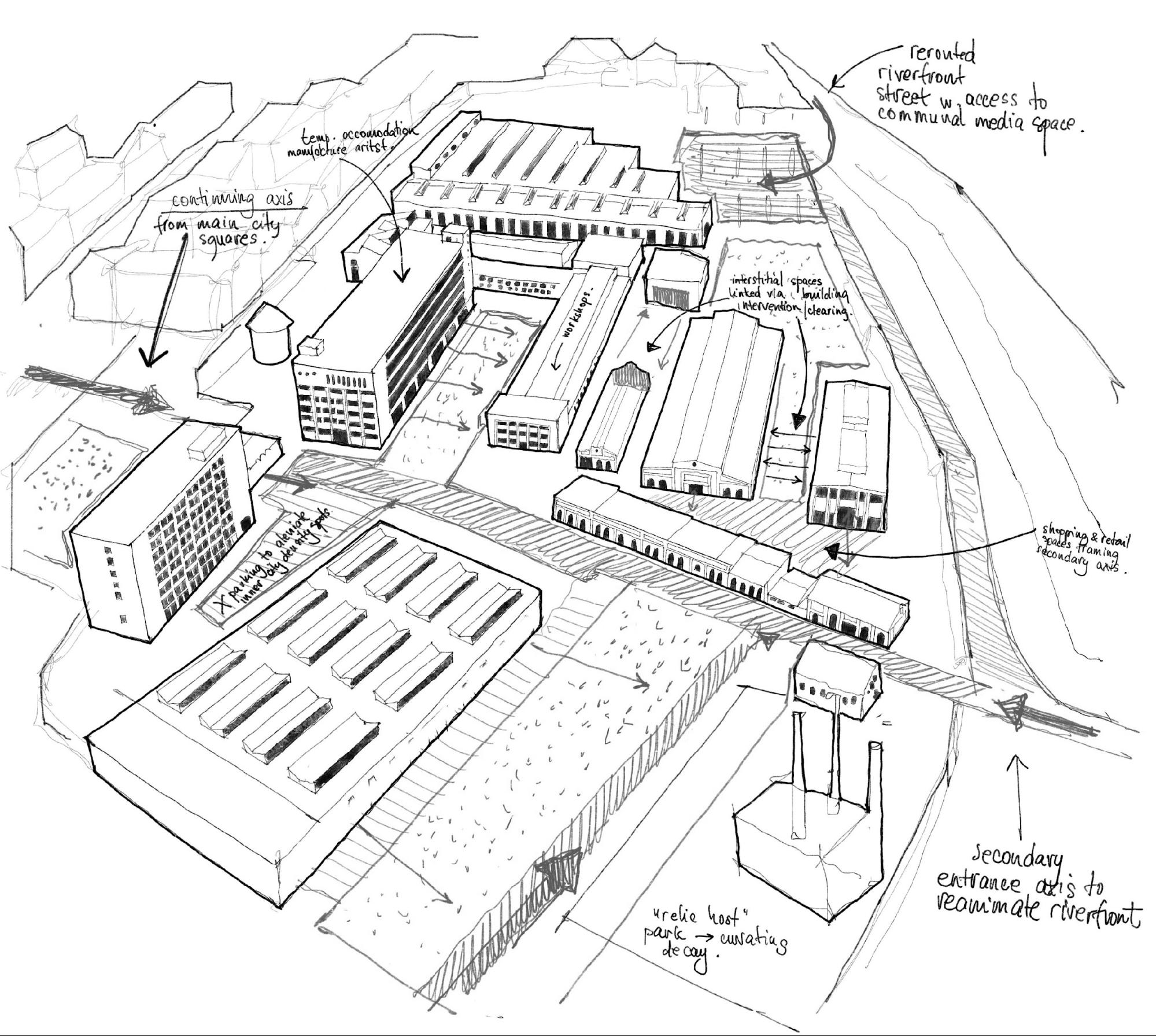
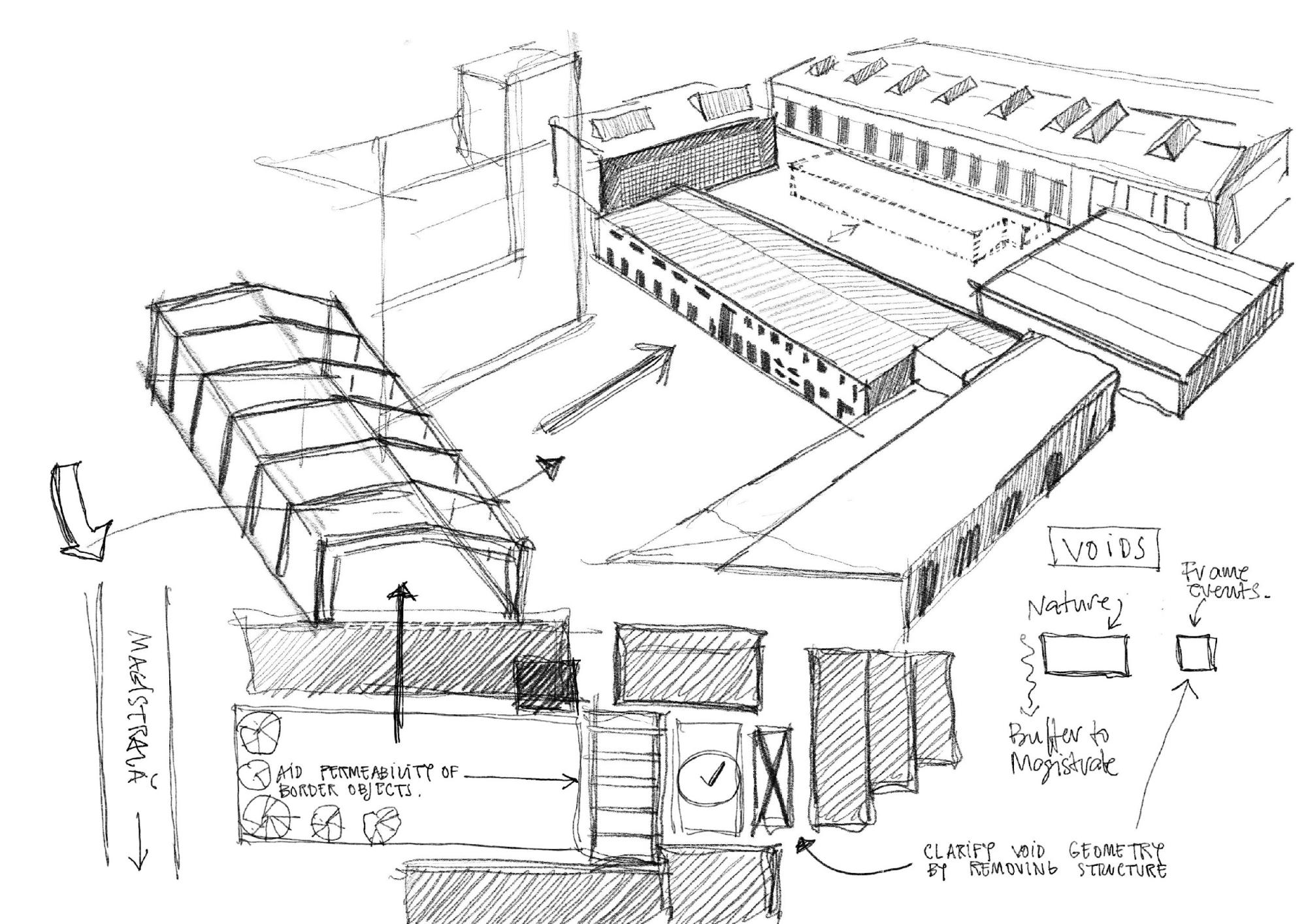
The next phase involved identifying and naming the main agents within the site so as to reframe them as bodies in need of protection and care rather than synthetic objects one could operate upon without scruple. The immediate contact revealed four primary actors and their relationships with the surrounding area: an enclosing wall, the buildings within the site, the natural agents that had taken over the site, and the interstitial spaces among the first three elements.
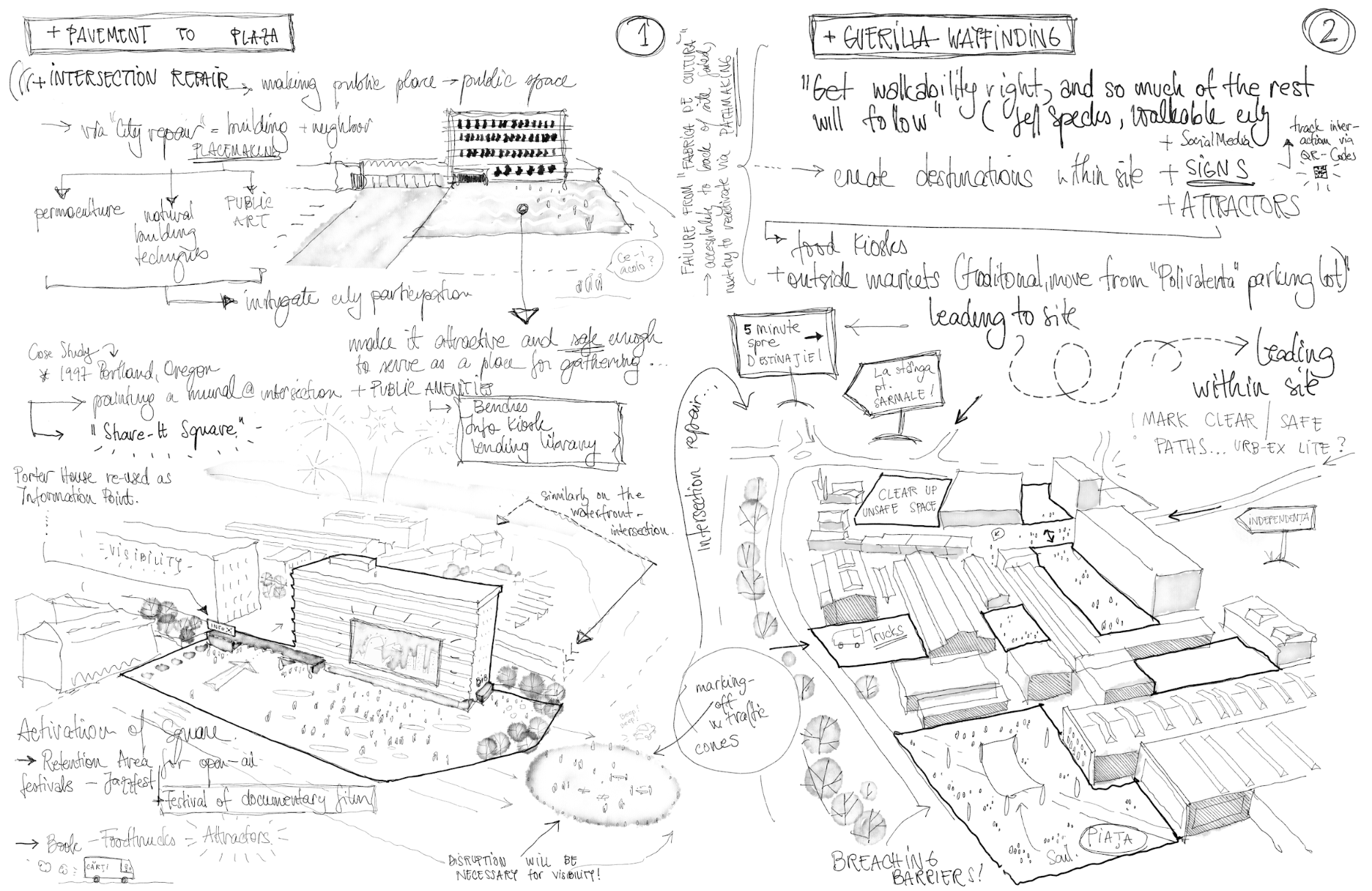
This stage included outlining the insular enclosure of the site and the surrounding urban microcontext, merging ad-hoc drawings with preliminary results of previous studies.
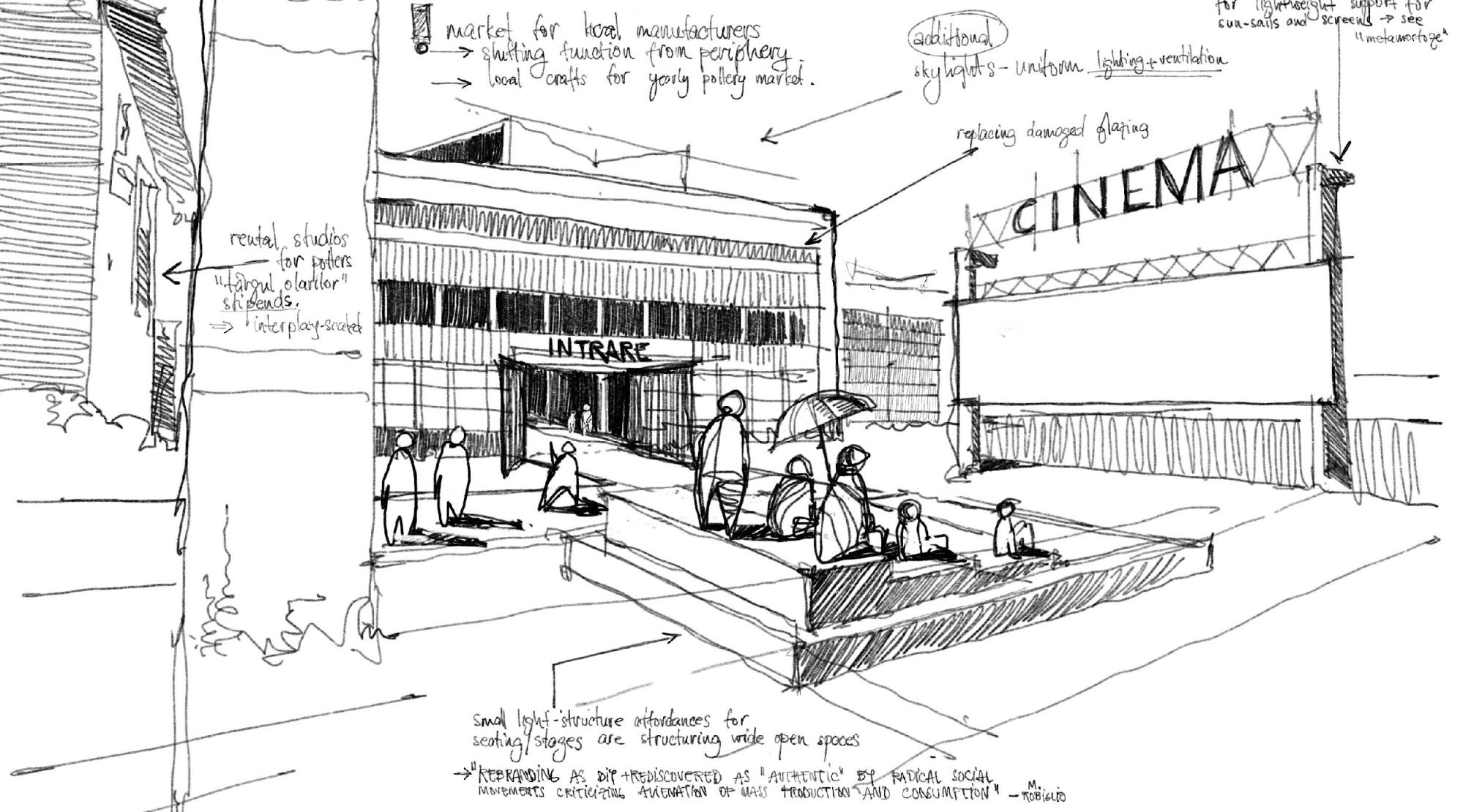
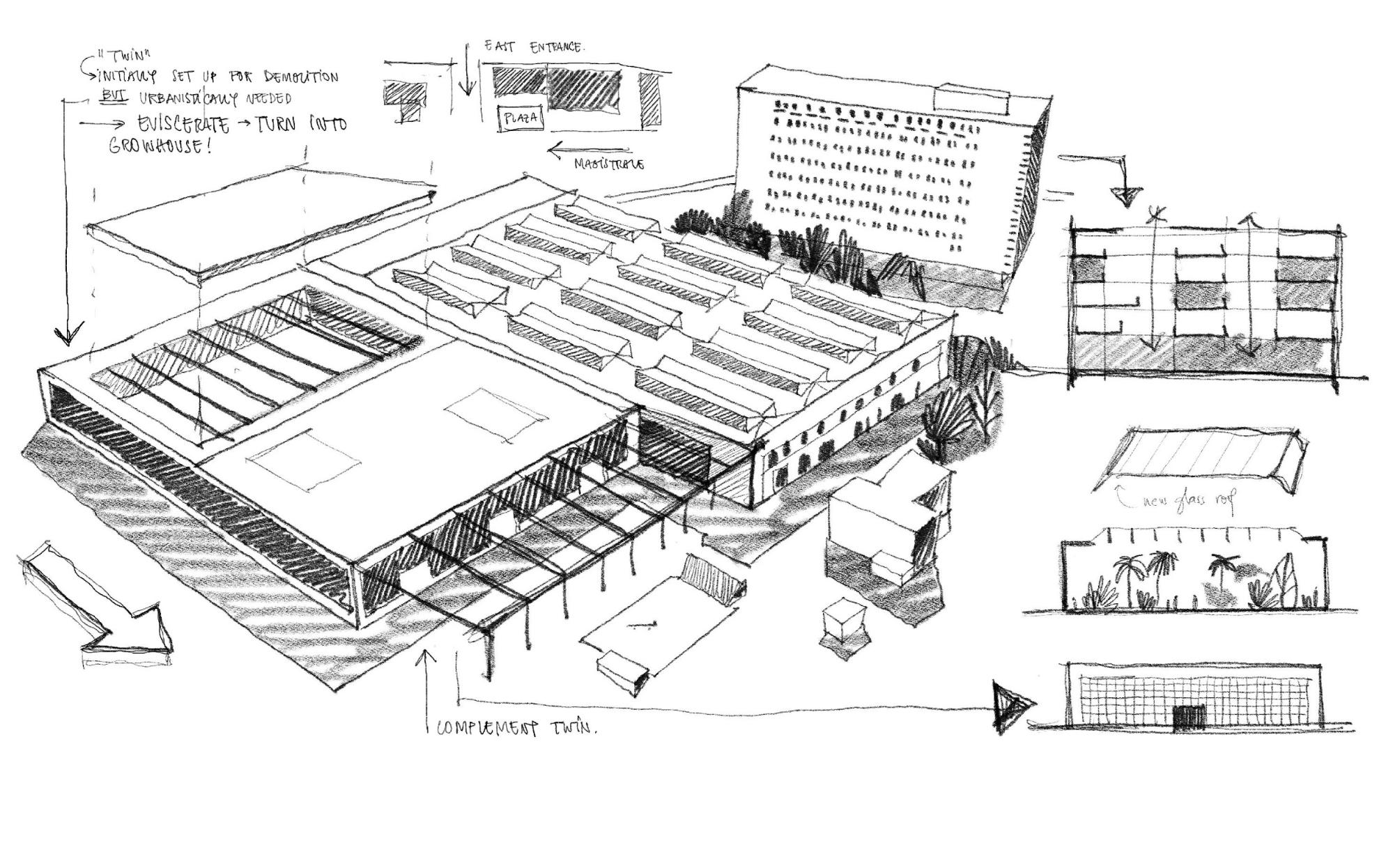
Multiple descriptive and atmospheric sketches were created alongside rough collages illustrating functional connections between the site and the surrounding city, aiming to determine what potential uses could be activated by and through the site. The hand drawings were further merged with phenomenographic films taken in the first stage, resulting in a series of video vignettes that followed the designer's engagement with the site. At the same time, the initial vague design intervention proposals began to overlap with the lived experience of existing within and navigating this environment.fig.3
This method resulted in two outcomes: the existing and the new were not depicted as opposing, easily distinguishable interventions, and it preserved a significant degree of fuzziness, which inhibited the immediate imposition of a defined and ultimate solution on the site. Consequently, the dynamic and fluctuating nature of both existing objects and design proposals was sustained.
The concepts of decay and the void were positioned, perhaps paradoxically, at the core of design thinking; the ambiguity of architectural presence and absence established a complex foundation for intervention strategies that challenged established and internalised approaches to architectural practice. As the design proposals ranged from essentially undoing spaces, inserting temporary actors, and adding new objects into the post-industrial landscape, the issue of addressing these modern wastelands transformed from a spatial to a psychological concern: is it possible to design within new ruins without being constrained by their "lost" origin, as they hold dreams, fancies, and memories of things that "were" but are no longer?16 Making sense of these adverse situations and the cultural context of the site, while still searching for design solutions necessitated proposals that were not yet fully developed. However, rough outlines started emerging. Due to the complexity of the dynamic pull between the necessity for ruins17 and the necessity for activation as a means to protect heritage, the employed design methods were decidedly non-linear and agile, as each site visit and survey uncovered new spatial, temporal, and socio-cultural situations that necessitated adjustments to design tactics. Recursive iterations encompassed the process of laying out the methodological traces within the phenomenographic representations.fig.4
Gaze shifting as a design process
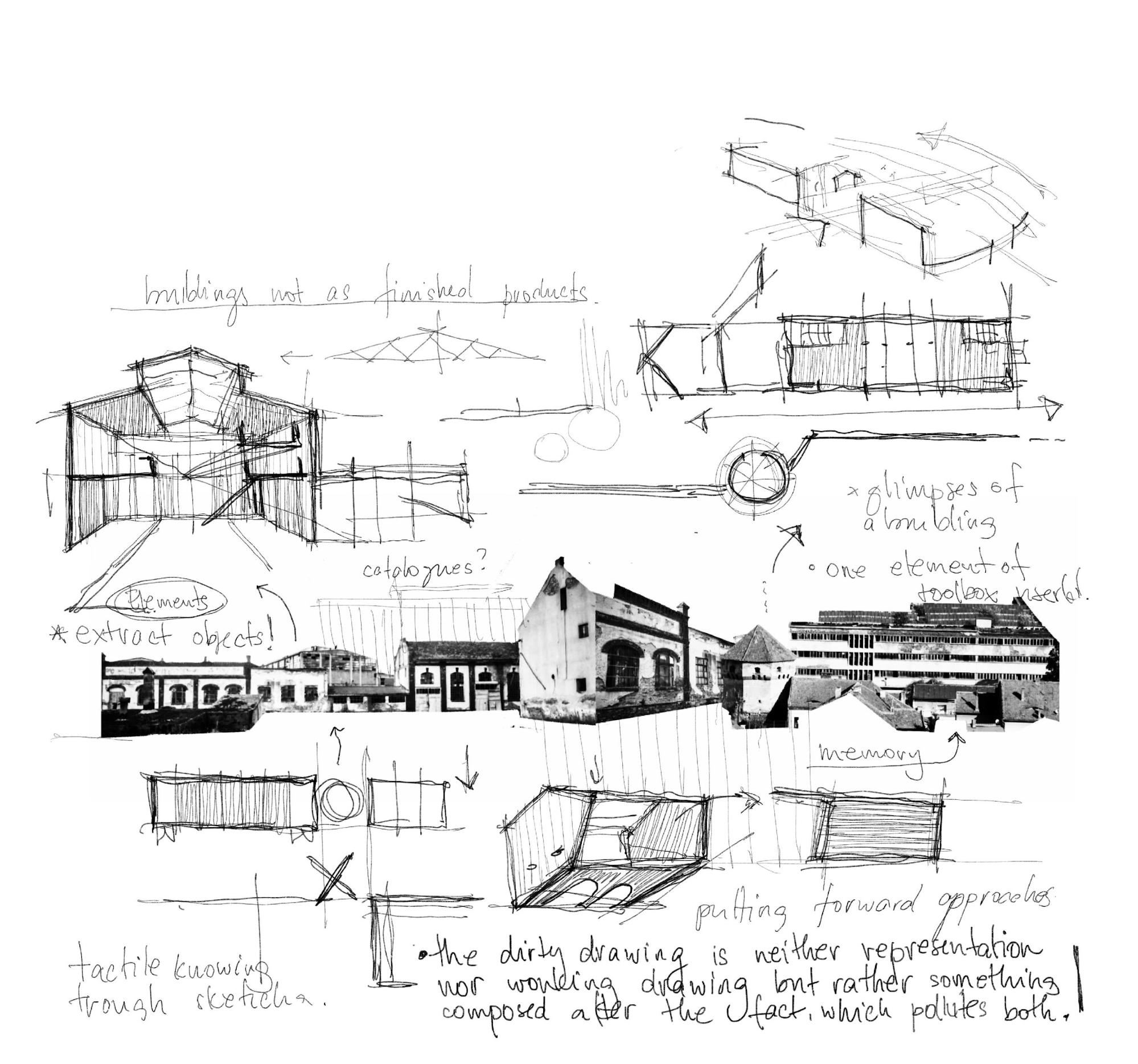
A consistent embodied practice was the use of hand drawings as a representational strategy and a means to loosely document tacit knowledge18 without a set aim to illustrate a ready-to-implement solution. Drawings were used as "thought protocols" and as ways of "dwelling within, or sustaining a moment"19 of the terrain vague20. This representation method most poignantly showcased the aforementioned tension between doing and "un"-doing (or doing nothing), as well as the information gaps contained by the ruin regarding its use, its history, etc. It also mediated between what is depicted and what is left out – the omissions create the space for interpretation21, continued reflection, and, eventually, a clear solution proposal.
The messy drawings encompassed the ever-mutating dynamic character of the site and, consequently, the intentional, design-driven, or natural processes that act upon them. These processes were subject to examination regarding their relation to design methods capable of representing proposals for reanimation while maintaining a high degree of reflexivity, subjectivity, and vagueness intended to spur an ongoing sustainable creative process, which could, in turn, stretch across various stages of development or decay. This approach presented a certain synchronicity with theories wherein the messiness of the creative act is being embraced through a feminist lens: as Jennifer Bloomer postulates, architectural processes are "dirty"22, more akin to childbirth than the clean production of an artificial object. Ruins are subjected to entropy, deterioration and finitude; these spaces and entities are closer to bodies than mere objects.fig.5
A shift in gaze regarding post-communist aesthetics was reflected in changing modes of spatial practice as well: “Feminist theories assert that things can be different and can extend beyond analytic modalities into practice-based, interventionist and activist modalities to propose, materialise and experience how things may become “otherwise”23. The ambiguity surrounding phenomenographic approaches to ruins – such as incomplete, abandoned, or outdated buildings – can serve as a foundation for design thinking that transcends the "illusion of permanency and completeness." This perspective encourages designers “to see designs not as final products, enclosed buildings" but rather as "an intermediate phase of development that is open-ended, anticipating future changes and generations"24.fig.6
Juhani Pallasmaa suggests that instead of simplifying architectural production to “mere aestheticisation,” engaging with the poetic dimensions of image and idea creation fosters the development of distinct modes of thought and representation that can express complex and interconnected phenomena25, such as, in our case, designing within preexistences.
Conclusion
This approach has shown its significance in projects involving ruins within challenging socio-political contexts, as it allows for navigation within complex ontological spaces and addresses issues that cannot be distinctly separated and classified into architectural and non-architectural categories. Consequently, the strategies discussed have the potential to facilitate communication among architects, clients, and stakeholders by enabling ideas to emerge that are not tied to a singular image but provide various entry points and can, due to their inherent uncertainty, be more adaptable to changes during the dynamic early phases of design processes.
Ultimately, such design interventions should be understood as a brief glimpse into a potential future of architectural methodologies that move away from the exceptionalist perspective of the architect as the sole author of final, immovable, and unchangeable object-buildings that are, in essence, still detached from their physical and political context. Instead, the proposal advocates for design practices to draw from various epistemic fields in order to preserve and enhance knowledge and values already embodied in existing architectures.
Literaturverzeichnis
Altunok, Nilsu (2022): Revealing the Tacit: A Critical Spatial Practice Based on Walking and Re/Presenting, in: https://doi.org/10.3929/ethz-b-000628254.
Cairns, S. & Jacobs, J. Buildings Must Die: a perverse view of architecture. MIT Press. 2017.
Edensor, Tim. Industrial Ruins Space, Aesthetics and Materiality. 1st ed. Bloomsbury Publishing. 2005.
Floris, Alkemade, van Iersel, Michiel, Minkjan, Mark & Ouburg, Jarrik (Ed.). Rewriting Architecture – 10+1 Actions: Tabula Scripta. Academy of Architecture. Amsterdam 2020.
Frichot, Hélène. How to Make Yourself a Feminist Design Power Tool. The Practice of Theory and the Theory of Practice. Spurbuchverlag. Baunach. 2016. Creative Ecologies: Theorizing the Practice of Architecture. London; Bloomsbury Visual Arts. New York 2018.
Frichot, H., Gabrielsson, C. & Runting, H. (Ed.). Architecture and feminisms: ecologies, economies, technologies. Routledge. 2018.
Graziano, Valeria & Trogal, Kim (2019). Repair Matters. Ephemera Journal 19 (2): p. 203–27.
Haraway, Donna. Simians, Cyborgs, and Women: The Reinvention of Nature. Routledge. New York 1991.
Ingold, Tim & Vergunst Jo Lee (Ed.). Ways of Walking: Ethnography and Practice on Foot. Anthropological Studies of Creativity and Perception. VT: Ashgate. Aldershot, England; Burlington 2008.
Jackson, John Brinckerhoff. The Necessity for Ruins, and Other Topics. University of Massachusetts Press. Amherst 1980.
Koolhaas, Rem & Otero-Pailos, Jorge. Preservation Is Overtaking Us. Gsapp Transcripts. Columbia University Press. 2014.
Lindström, Kristina, Mazé, Ramia, Forlano, Laura, Jonsson, Li & StåhlÅsa (2018). Editorial: Design, Research and Feminism(s), in: https://doi.org/10.21606/drs.2017.005.
O’Callaghan, Cian & Di Feliciantonio, Cesare (Ed.). The New Urban Ruins: Vacancy, Urban Politics and International Experiments in the Post-Crisis City. Urban Policy, Planning and the Built Environment. Policy Press.
Bristol 2021.
Pallasmaa, Juhani. The Embodied Image: Imagination and Imagery in Architecture. AD Primers. Chichester: Wiley. 2011.
Pasel, Ralf & Paans. Otto. Thinking through Designing: Design Theory 2017–2020. CODE / Architectural Files 11. Universitätsverlag der TU Berlin. Berlin 2022.
Pilia, E. Urban ruins: memorial value and its contemporary role. DOM publishers. 2019.
Polanyi, Michael & Sen, Amartya. The Tacit Dimension. University of Chicago Press. Chicago; London 2009.
Pușcă, A. (2010). Industrial and Human Ruins of Postcommunist Europe. Space and Culture. https://doi.org/10.1177/1206331210365255
Rendell, Jane (2018). Only Resist: A Feminist Approach to Critical Spatial Practice. Architectural Review, 2018. Last access at 14.01.26 on https://www.architectural-review.com/essays/only-resist-a-feminist-approach-to-critical-spatial-practice.
Sonnemann, U. Existence and therapy: an introduction to phenomenological psychology and existential analysis. Gestalt Legacy Press. 1999.
Troiani, Igea & Ewing, Suzanne. Visual Research Methods in Architecture. 2021.
